Is Elly Rise medical advice?
No. Elly Rise helps with symptom tracking, reflection, and visit preparation. It does not diagnose conditions or recommend treatment.


Meet Elly. Designed for arthritis, chronic pain, and fatigue-heavy routines, Elly Rise helps you track pain, stiffness, fatigue, flares, and triggers without turning the day into more admin.
Elly Rise is built for people who want a gentler symptom tracker for chronic pain, arthritis, fibromyalgia, hypermobility, or similar day-to-day symptom patterns.
It is especially useful when you want cleaner notes about pain, stiffness, fatigue, flare-ups, triggers, and appointment prep.
Log joint pain, morning stiffness, and flare-up triggers in seconds using quick presets. Start with one tap, then check in again when you feel better.
Keep a light record of fatigue, possible triggers, weather context, and short notes so symptom changes still make sense later.
Bring clearer history into rheumatology, pain, or primary-care visits with a summary that is easier to review than scattered notes.
Explore features designed for real life, high-fatigue days, and clinical readiness.
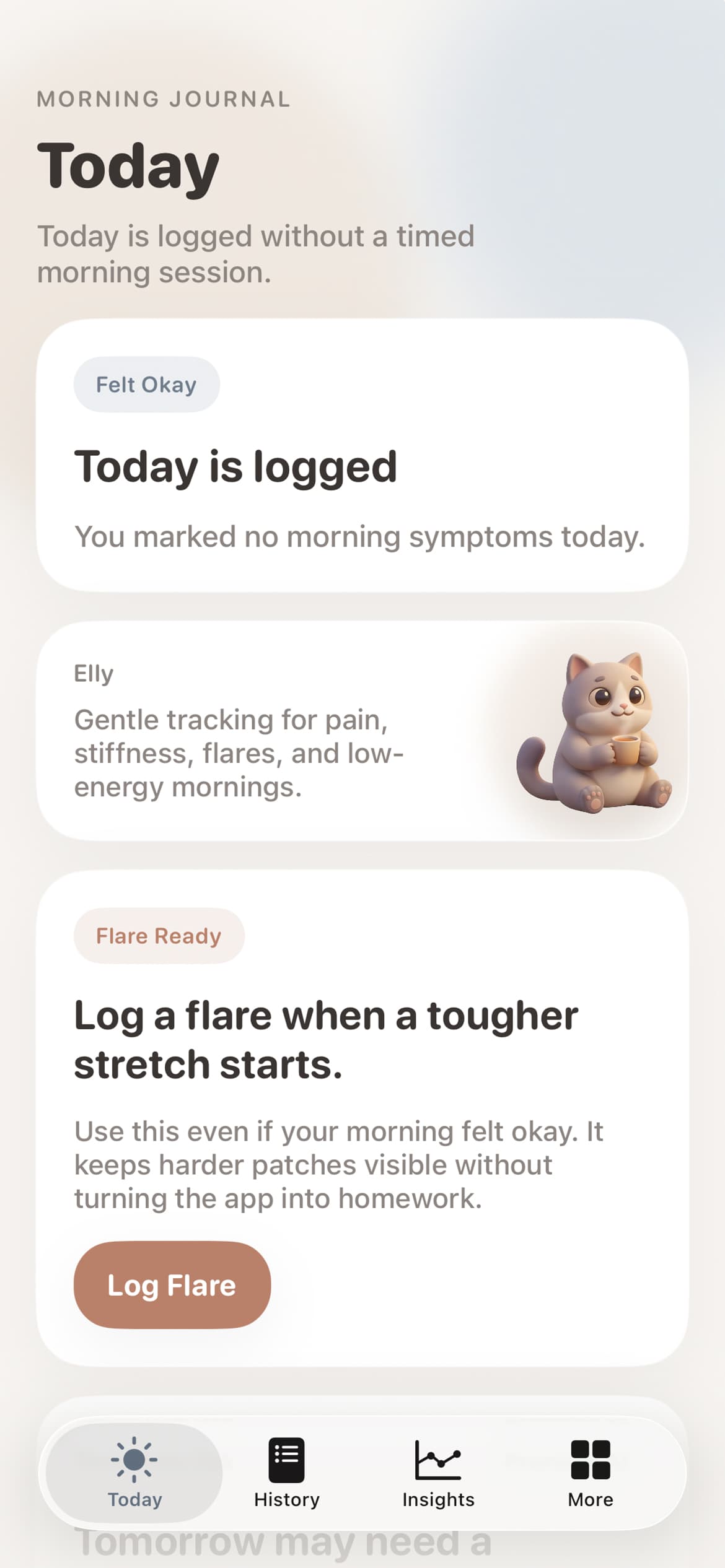
Start your morning with a quick, intuitive log. Check in with your pain levels, fatigue, and triggers without getting bogged down by endless forms.
Elly Rise is built around real mornings, not perfect routines.
Tap to start when your morning symptoms begin.
Log faster with quick presets and progressive fields.
Receive adaptive gentle reminders that adjust to your rhythm.
See symptom and context patterns without digging through notes.
Designed for real life
Premium AI insights
Our premium features unlock optional AI-powered summaries. Notice patterns that may be hard to spot in raw logs, including links between your symptoms, notes, weather context, and recent routines.
Premium features may include:
AI insights support reflection and preparation. They form no diagnosis or treatment plan.
Local First
Your journal data fundamentally belongs to you. Elly Rise stores your primary logs directly on your device using local storage.
We do not sell data, use tracking SDKs to siphon activities, or push you to cloud storage if you do not want it.
Explicit AI Consent. Our AI features are opt-in. Before they are enabled, we identify OpenAI as our third-party AI provider and explain that selected symptom logs, notes, and weather context may be processed for those optional features.
What Elly Rise Helps You Track
Chronic pain and arthritis rarely show up as one simple number. A hard week might include pain, fatigue, morning stiffness, flare timing, and a vague sense that something changed before it got worse. Elly Rise is built to hold onto those details while they are still fresh.
The app is designed to stay usable on low-energy days, when a heavy tracker is most likely to be skipped. That makes the record more sustainable and more helpful when you need to review patterns before an appointment.
Who It Is For
Elly Rise is meant for people who want a calmer way to keep symptom history without pretending that more tracking is always better. The product is designed to support reflection and care conversations, not to replace them.
That means keeping the privacy story visible, keeping optional AI behind consent, and making the public site clear about what the app does and does not do.
See how quick daily logging, context capture, and visit prep fit together.
Review how Elly Rise helps patients arrive with clearer notes for care visits.
Review the local-first approach, support workflows, and optional AI consent details.
Download Elly on iOS and start tracking pain, fatigue, stiffness, flares, and triggers in a gentler daily routine.
Download from the App Store
Common Questions
No. Elly Rise helps with symptom tracking, reflection, and visit preparation. It does not diagnose conditions or recommend treatment.
The main use cases today are pain, fatigue, stiffness, flare timing, and short notes about triggers or day-to-day changes.
Because health-adjacent products should be clear about what stays local, what support flows through the website, and what optional AI features require consent.
Yes. There is a clinician page, sample report, and patient handout to show how symptom history can fit into the visit without a new portal.
Condition Resources
Elly Rise is built for day-to-day symptom tracking, not diagnosis. If you are researching arthritis, autoimmune disease, chronic pain, hypermobility, or connective tissue conditions, these official medical resources are a strong place to start.
NIAMS
Learn the basics of osteoarthritis, including common symptoms, affected joints, and treatment approaches from NIAMS.
Read official Osteoarthritis informationNIAMS
Review symptoms, causes, and treatment guidance for psoriatic arthritis from the National Institute of Arthritis and Musculoskeletal and Skin Diseases.
Read official Psoriatic Arthritis informationNIAMS
Find medical information about ankylosing spondylitis, including spine-related symptoms, flares, and treatment options.
Read official Ankylosing Spondylitis informationNIAMS
Explore an overview of fibromyalgia symptoms, fatigue, pain sensitivity, and treatment approaches from NIAMS.
Read official Fibromyalgia informationNIAMS
Read an official lupus overview covering symptoms, flares, organ involvement, and treatment context.
Read official Lupus informationThe Ehlers-Danlos Society
Get condition information about hypermobile Ehlers-Danlos syndrome from the Ehlers-Danlos Society.
Read official Hypermobile EDS informationThese external resources are provided for general education only and do not replace professional medical advice.
Explore Pages
These pages go deeper into the use cases people actually search for, from chronic pain tracking to appointment prep and clinician-facing reporting.
Read the full logging flow and how Elly Rise supports care conversations.
Read moreSee how daily pain, fatigue, and flare tracking stays light enough to keep up.
Read moreExplore tracking for pain, stiffness, fatigue, and flare patterns in arthritis.
Read moreReview how symptom history becomes more useful before rheumatology or pain visits.
Read more